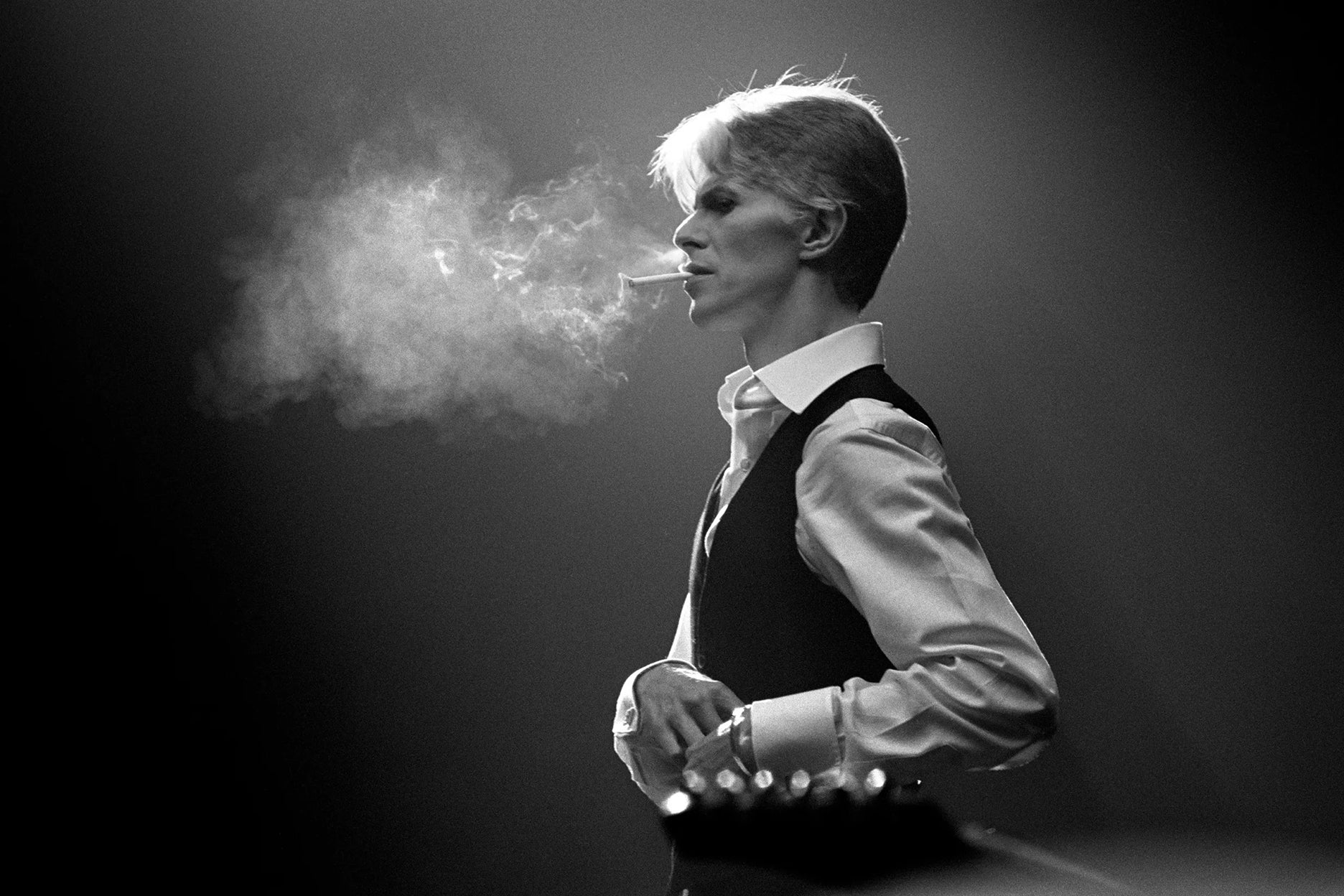
In 1974, David Bowie was touring America for his “Diamond Dogs” album, an intensely creative but also physically and emotionally grueling time. He eventually settled in Los Angeles, where he recorded “Station to Station,” starred in “The Man Who Fell to Earth,” and developed the ascetic, haunted persona of the Thin White Duke. Living in near isolation and deep addiction, Bowie’s time in Southern California was a harrowing chapter, but one that produced some of his most enduring and enigmatic work…
In 1974, David Bowie was touring America for his “Diamond Dogs” album, an intensely creative but also physically and emotionally grueling time. He eventually settled in Los Angeles, where he recorded “Station to Station,” starred in “The Man Who Fell to Earth,” and developed the ascetic, haunted persona of the Thin White Duke. Living in near isolation and deep addiction, Bowie’s time in Southern California was a harrowing chapter, but one that produced some of his most enduring and enigmatic work…
One of David Bowie’s worst ideas was to think he could hide from Ziggy Stardust in a place like Los Angeles. In 1973, he announced from the stage of London’s Hammersmith Odeon, “Not only is this the last show of the tour, but it’s the last show that we’ll ever do.” To audible shrieks from the audience, as captured by filmmaker D.A. Pennebaker, Bowie allowed his creation to succumb to the “Rock ‘n’ Roll Suicide” as prophesied on his first major hit record, Ziggy Stardust and the Spiders from Mars (1972).
“I realized I had become a total product of my concept character Ziggy Stardust,” Bowie told Cameron Crowe in a conversation for Playboy in 1976. “So I set out on a very successful crusade to re-establish my own identity. I stripped myself down and took myself apart, layer by layer.”
Ziggy became Aladdin Sane (1973), a “schizoid” permutation of his celebrated orange-haired extraterrestrial, with a flash of brightly colored lightning cutting through the right side of his Kabuki-white face. And by the time Bowie had become Halloween Jack for the Diamond Dogs (1974) record, he was a bit too keen for cocaine and at a crossroads, so to speak—prepared to consort with the devil himself if it took him somewhere truly new. So, he moved to Los Angeles. Not to the English countryside, not back home to Brixton, not even to New York City. He left for the West Coast to a city fully engorged by myth, in pursuit of truth. No wonder he went nuts.
“He felt the pool in his L.A. home was haunted,” recounts Deep Purple’s Glenn Hughes, with whom Bowie struck up an unlikely friendship in 1975 while both were holed up in the Beverly Hills Hotel. “He felt the devil was in the pool. We had been up for a couple of days, and the wind must have been howling because the water started to bubble in the pool. It bubbled like it was a jacuzzi. I have a pool and I have never seen it bubble before. But that fucking pool was bubbling. Do yourself a favor. Stay up for seventy-two hours and you will see shit move. You’ll see a box fall off your table. You’ll hear things. We were just so damn high.”
Depending on who you ask and, especially, who you believe, the fact that Bowie hired an exorcist to deal with the demonic gurgling in his backyard may or may not be true. What is true, is that Bowie had descended into one of the darkest periods of his life. Fueled mostly by his ever-increasing cocaine and stimulant abuse, his weight dropped dramatically, his skin turned a vampiric ghostly white, and he was dogged by a paranoia he couldn’t shake.
He claimed to see bodies falling from the sky outside his windows. He plunged further into his fascination with Kabbalah, the occult, and Aleister Crowley. More disturbingly, he pondered aloud in interviews about fascism and Adolf Hitler, suggesting the latter was the world’s first rock star. In other words, a rapid descent from Space Oddity’s “ground control” to an ill-advised interest in crowd control. He also, most infamously, lived on a diet made entirely of milk and green peppers.
“There’s a fly floating around in my milk,” Bowie says, drinking from a large carton in the backseat of a limousine, in the BBC documentary Cracked Actor (1974). “There’s a foreign body in it, you see? And it’s getting a lot of milk. That’s kind of how I felt [moving to Los Angeles]. A foreign body. And I couldn’t help but soak it up. I hated it when I first came here, I couldn’t see any of it… Look, there’s a wax museum!”
It was this footage that inspired director Nicolas Roeg to cast Bowie in his film, The Man Who Fell to Earth (1976). The story of a Martian adrift in New Mexico seemed tailor-made for Bowie, although that wasn’t the initial plan. “I saw Alan Yentob’s film Cracked Actor,” Roeg recalled. “Casting is strange. Usually an actor comes for a part, but on other occasions the part seems to just go towards one actor.”
By most accounts, Bowie kept his promise to stay clean during the shoot, proving to be a worthwhile actor, finding meditative pleasure in the repetition of line reads and multiple takes of the same scene. Although, in later years, the singer would admit he didn’t recall much of the production and was still very much in the throes of cocaine addiction. A testament to the mercurial singer’s unsurpassed ability to reinvent himself and inhabit creatures of his own design, Roeg gave Bowie full reign to assemble his own image—his orange-vanilla dyed hair, pale skin, fedora, and blue-lensed glasses all came fully formed to the film set.
Often referred to as Bowie’s “lost” year, 1975, in fact, turned out to be one of the more fascinating transformations in a career devoted to making as many of them as possible. The film wrapped in 11 weeks, and he was back in Los Angeles scribbling stories in a collection to be called “The Thin White Duke.” He eventually abandoned the book, and the titular character became yet another persona to inhabit—the rail thin, drug addled, Aryan amalgamation of all the misguided indulgences he luxuriated in while living in a city he came to despise. The resulting recording, Station to Station (1976), would produce his second top ten single in America, “Golden Years,” and eventually inspire him to flee Southern California for Berlin, with his friend Iggy Pop in tow.
As it turns out, Los Angeles was the perfect place for Bowie to shed his gathered personas, to leave them behind in a city too full of them to notice.
“One half of me is putting a concept forward, and the other half is trying to sort out my own emotions,” Bowie says to Yentob in Cracked Actor. “A lot of my space creations are, in fact, facets of me. Ziggy would be something and it would relate to me… Major Tom in Space Oddity… Aladdin Sane, they’re all facets of me. I got lost in it. I couldn’t decide whether I was writing characters or whether the characters were writing me. Or, whether we were all one and the same.”

WRITTEN BY Gregg LaGambina
#music