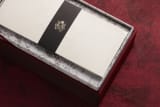
The crisp white dial is framed by a gold-plated case of precise proportion, its surface catching the light with quiet authority. Steel hands sweep across Roman hour markers—an unmistakable Cartier signature—balancing legibility with ceremonial elegance. The composition is both graphic and harmonious, a study in contrast and clarity that reflects the brand’s long-standing mastery of functional luxury.
Powered by a quartz movement and presented in its original red leather–lined case, the clock embodies Cartier’s belief that even the most utilitarian objects deserve beauty, balance, and permanence. Whether placed on a desk, bedside table, or shelf, it stands as a small architectural object, where Swiss precision meets Parisian refinement in a form that feels resolutely timeless.
Cartier alarm clock (pendulette), c. 1990s
AVAILABLE IN
1 COLOR
3,500 USD
The crisp white dial is framed by a gold-plated case of precise proportion, its surface catching the light with quiet authority. Steel hands sweep across Roman hour markers—an unmistakable Cartier signature—balancing legibility with ceremonial elegance. The composition is both graphic and harmonious, a study in contrast and clarity that reflects the brand’s long-standing mastery of functional luxury.
Powered by a quartz movement and presented in its original red leather–lined case, the clock embodies Cartier’s belief that even the most utilitarian objects deserve beauty, balance, and permanence. Whether placed on a desk, bedside table, or shelf, it stands as a small architectural object, where Swiss precision meets Parisian refinement in a form that feels resolutely timeless.
A refined expression of Cartier’s enduring design language, this Swiss-made alarm clock pendulette from the 1990s distills the maison’s classical codes through a distinctly modern lens. Compact yet commanding, its architectural form recalls the disciplined geometry and polished restraint that link Mid-Century Modern design to the lingering influence of Art Deco.
Gold-Plated Case with White Dial
Quartz Movement
Zephirin
In the years leading up to World War II, spectacles ceased to be simply corrective instruments and began to shimmer with new possibilities. What began as innovation in plastics and etching, as engineering solutions for comfort and fit, evolved into something larger: eyewear as self-expression. By the eve of the Second World War, glasses were no longer the discreet scaffolding of vision but part of the architecture of identity itself, shaping faces as much as they clarified sight. From the salons of Paris to the soundstages of Hollywood, eyewear became a cultural accessory, a coded language of glamour, intellect, and intrigue.
As we mark ten years of Jacques Marie Mage, we return to where it all began: the nascent sparks, the first bold forms, the foundational silhouettes that set our course. With Origins, the inaugural offering from Réserve by JMM, we invite you to rediscover the earliest expressions of our ethos—limited-edition spectacles from the first season of the Circa Collection, which consisted of exactly four styles: the Dealan, Zephirin, Hatfield, And Fountainebleau.
Italian-handcrafted hard leather case
Microfiber cleaning cloth/pocket square
Hard-shell, silk fabric-covered packaging
Letterhead press certificate with limited edition serial number and craftsmen signature