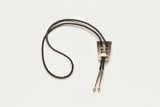
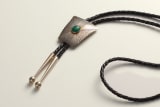
Centered by an oval malachite cabochon whose swirling bands evoke a contour map rendered in shades of green, this Navajo bolo tie reflects the remarkable precision of Southwestern silverwork. Hand-fabricated sterling rays radiate from the stone in a composition whose crisp geometry recalls the bold graphic forms that distinguished Navajo jewelry throughout the twentieth century.
Although often associated with ranches and rodeos, the bolo tie found an unexpected second life after the Second World War. By the 1960s, it had become a familiar sight far beyond the range, appearing beneath tailored jackets in state capitols and trading posts across Arizona and New Mexico. In Barry Goldwater’s Arizona, the bolo could sit beneath a suit jacket without losing its desert provenance, carrying the authority of regional dress into rooms built for legislation, commerce, and debate.
The broad malachite cabochon lends unusual visual weight to this composition, while the disciplined silverwork reflects a lineage shaped by generations of Navajo lapidaries and silversmiths whose work transformed local materials into one of the defining jewelry traditions of the American West.
Navajo bolo tie
AVAILABLE IN
1 COLOR
350 USD
Centered by an oval malachite cabochon whose swirling bands evoke a contour map rendered in shades of green, this Navajo bolo tie reflects the remarkable precision of Southwestern silverwork. Hand-fabricated sterling rays radiate from the stone in a composition whose crisp geometry recalls the bold graphic forms that distinguished Navajo jewelry throughout the twentieth century.
Although often associated with ranches and rodeos, the bolo tie found an unexpected second life after the Second World War. By the 1960s, it had become a familiar sight far beyond the range, appearing beneath tailored jackets in state capitols and trading posts across Arizona and New Mexico. In Barry Goldwater’s Arizona, the bolo could sit beneath a suit jacket without losing its desert provenance, carrying the authority of regional dress into rooms built for legislation, commerce, and debate.
The broad malachite cabochon lends unusual visual weight to this composition, while the disciplined silverwork reflects a lineage shaped by generations of Navajo lapidaries and silversmiths whose work transformed local materials into one of the defining jewelry traditions of the American West.
Navajo sterling silver bolo tie featuring an oval malachite cabochon in a hand-fabricated geometric mount, with braided black leather cord and sterling silver tips. Signed “TB” and marked sterling on the reverse.
Each Reserve collectible is thoughtfully custom-packaged to Jacques Marie Mage standards, with tailored care to each artifact. Each collectible is accompanied by a JMM Certificate of Authenticity and ID card.